What can we
help you find?
Ricerche suggerite

"FASHION TO RECONNECT": Reflections one month after the Hong Kong festival. Michelangelo Pistoletto opens up to Harper's Bazaar
One month after the conclusion of "FASHION TO RECONNECT: A Tale of Two Style Capitals," the international exhibition that intertwined fashion, art, and sustainability between Italy and China, we retrace the project's key moments, its protagonists, and the reflections that emerged. The story is summed up in the words of Cittadellarte's founder, whose full interview with Harper's Bazaar Hong Kong is published below. This contribution delves into the significance of the Third Paradise as a cultural, social, and political perspective for the present.
Concluded on 24 December 2025, FASHION TO RECONNECT: A Tale of Two Style Capitals now stands as a complex cultural project, capable of activating a concrete dialogue between Italy and Hong Kong through the languages of fashion, art, and sustainability.
Promoted by the College of Liberal Arts and Social Sciences of City University of Hong Kong together with Fondazione Pistoletto Cittadellarte, in partnership with the Camera Nazionale della Moda Italiana and as part of the Hong Kong Fashion Fest, the programme unfolded through a rich calendar of exhibitions, urban installations, and moments of interdisciplinary exchange.
At the heart of the project was the exhibition hosted at ArtisTree, Taikoo Place, which brought together 9 Hong Kong–based designers and 16 Italian designers and brands, presenting fashion as a cultural practice capable of questioning the relationship between production, responsibility, and humanity’s connection with nature. The values of care, transformation, connection, and responsibility ran throughout the entire exhibition, outlining a shared vision of sustainability as a collective cultural process.
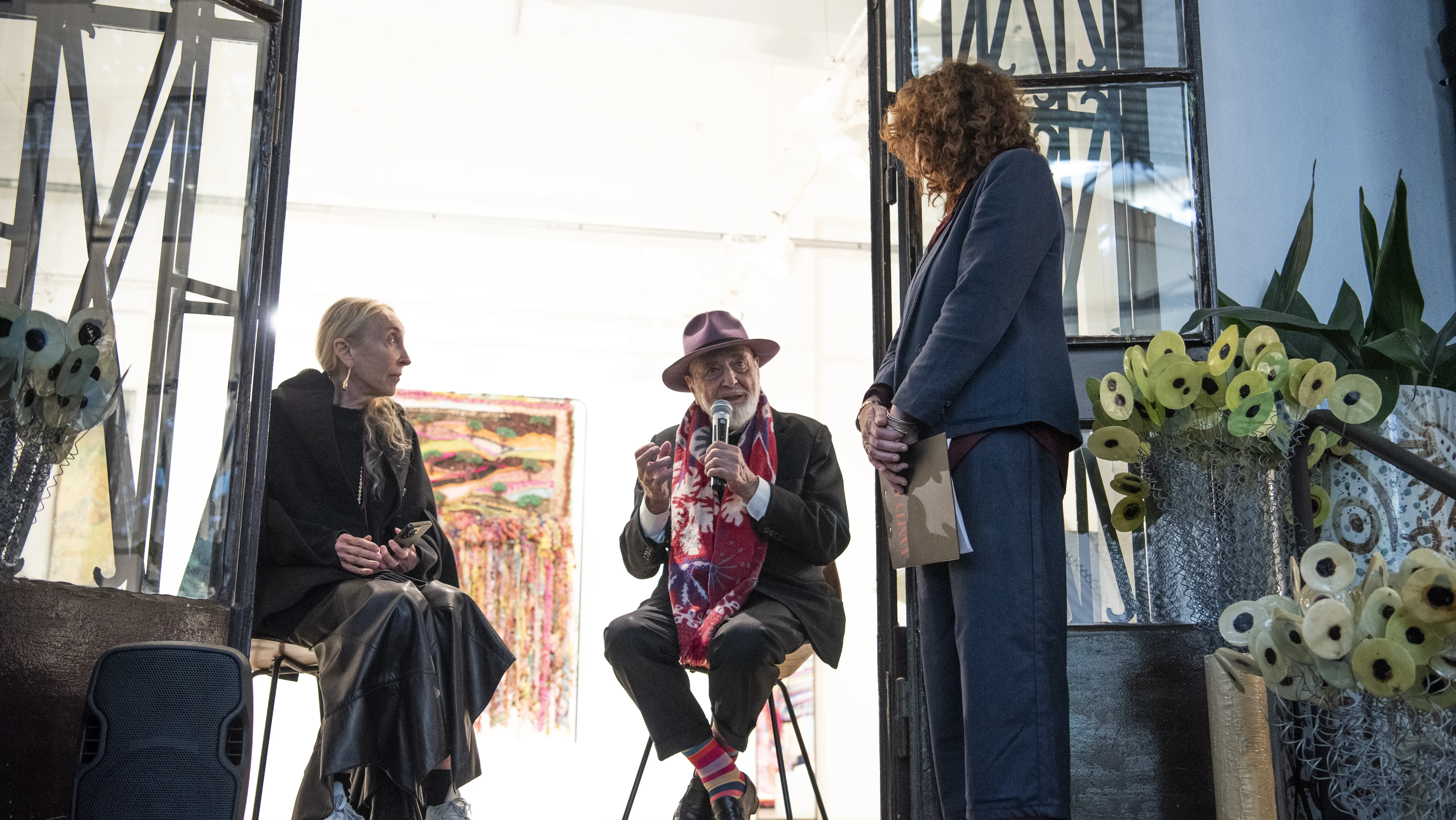
Alongside the exhibition, six Third Paradise installations extended the project into the urban space, while symposia, roundtables, and seminars fostered direct dialogue among institutions, designers, curators, and researchers, reinforcing the idea of connection as an active and operative practice rather than a merely symbolic one. Within this framework, the thinking of Michelangelo Pistoletto took on a particularly incisive form, engaging with the Asian context while preserving its universal strength.
From the collective narrative to the artist’s voice
If FASHION TO RECONNECT demonstrated how the dialogue between fashion, art, and sustainability can become concrete action, the interview Michelangelo Pistoletto gave to Harper’s Bazaar Hong Kong represents a kind of theoretical and symbolic condensation of that experience. In his words, the Third Paradise is not merely a sign, but an operative perspective: an invitation to recognise the responsibility that arises from encounters between individuals, cultures, and systems.
It is from this awareness that we present the full interview below, conceived as a space for deeper reflection and as a tool of continuity between the experience lived in Hong Kong and the broader international path of inquiry pursued by Cittadellarte.


How would you explain the Perspective of the Third Paradise to an audience that is not yet familiar with it?
Michelangelo Pistoletto: The Third Paradise is composed of three consecutive circles. The symbol of infinity, which many people know, is created with a line that, by crossing itself, produces two circles. The Third Paradise, however, is created by crossing the line twice, generating three consecutive circles. The two outer circles represent all different and opposing elements, all subjects, or elements, or words and their diverse meanings. All the elements that meet in the central circle produce a new element that did not exist before: this is the symbol, the formula of creation.
The central circle represents existence, life, at the center of infinity. On one side there is one element, on the other there is another, and in the center a new creation is born. The Perspective of the Third Paradise consists of balancing nature, which is in one circle, and artifice, which is in the opposite circle, harmonizing the central circle. This new perspective avoids continuing in conflicts of incompatibility, which unfortunately are growing in society, and balances nature with artifice.
Which works and phases of your career have given you the greatest satisfaction?
Michelangelo Pistoletto: The most important works are the mirror paintings. In these paintings, we see the representation of existence, completely open to infinity, through the reflection in the mirror, which represents everything that is in front of it: the reality of life. The mirror painting opens the perspective of infinite vision of existence in front of the viewer’s eye. The viewer, in turn, is reflected on the surface of the mirror painting as an image, as a witness, and as a key to interpretation, becoming also a protagonist. They participate in the reflection of the painting, which includes all thinking people and all existence.
What would you like the people of Hong Kong to learn from your work, and in particular from the upcoming exhibition?
Michelangelo Pistoletto: I would like the people of Hong Kong, as well as everyone else in the world, to learn through direct participation in the symbol that emerges from the mirror painting. It is the symbol of infinity that arises from the mirror work. The symbol of the Third Paradise is the symbolic translation of the mirror painting, and within this symbol, we are all included. Each person is positioned and represented in a circle, and any other person can be represented in the opposite circle. In the central circle, each person must find a necessary understanding with the other person: you and I together form the “we.” This “we” produces a new society that we can develop with the awareness that we are responsible for our meeting and for what we create through it.
Why did you decide to start the “MetaWork” using QR codes and artificial intelligence, and are you satisfied with the results?
Michelangelo Pistoletto: The use of artificial intelligence is important to me because it represents the technological development of what I have created as an artwork, particularly in the mirror painting. The mirror painting includes all existing people and all existing time and space. Integrated into a technological system, it becomes a practical system that introduces all of us physically, as if we were actually entering the mirror painting, not just through the image. Artificial intelligence includes all of us as in a large mirror, where we exist and communicate with each other in a practical way. The QR code was an important element to open an interactive dialogue with artificial intelligence.
In what way can your candidacy for the Nobel Peace Prize help promote social change and collective responsibility for the planet?
Michelangelo Pistoletto: My proposal to the world, through the symbol of creation and the symbol of the Third Paradise, is the formula of creation: an organization of Cittadellarte that extends and becomes a state of the art, a form of art that balances all contrasts. In this way, peace is truly realized through a process that never leads to war, but to balance, organized through union. The union of religions, businesses, and all activities is realized through a new method called demopraxy, which replaces the word power with the word practice. In traditional democracy, power remains power; demopraxy introduces a dimension of concrete and shared action, based on meeting and common responsibility.