What can we
help you find?
Ricerche suggerite

From Japan to Biella: Osaka's Maronie College returns to Cittadellarte for a responsible fashion workshop.
Ten students from the Maronie College of Fashion Design in Osaka participated in a three-day workshop at the Pistoletto Foundation, working on upcycling and natural dyes as part of Fashion B.E.S.T. Led by professors Masato Koide and Yuto Arita, along with the project team, they transformed Biella stock fabrics into original garments, concluding the experience with a final photoshoot that restored their energy and awareness.
From February 17 to 19, 2026, Cittadellarte welcomed ten students from the Maronie College of Fashion Design in Osaka for a workshop dedicated to responsible fashion, developed within the framework of Fashion B.E.S.T. activities. Leading the group—composed of students from different years of the program—were Professors Masato Koide and Yuto Arita, both of whom have been teaching at the Japanese institute for nearly a decade while simultaneously running their own independent brands.
For Koide, this was not a first-time experience. “I lived in Biella ten years ago,” he recounts during the interview given to our microphones. “I was already familiar with this place and with the work of Michelangelo Pistoletto. I liked the idea of bringing students here to study in such a context.” The collaboration between the College and Cittadellarte began in 2015, thanks to Professor Koide’s initiative, and resumed after the interruption caused by the pandemic. This year marks the fifth shared experience.
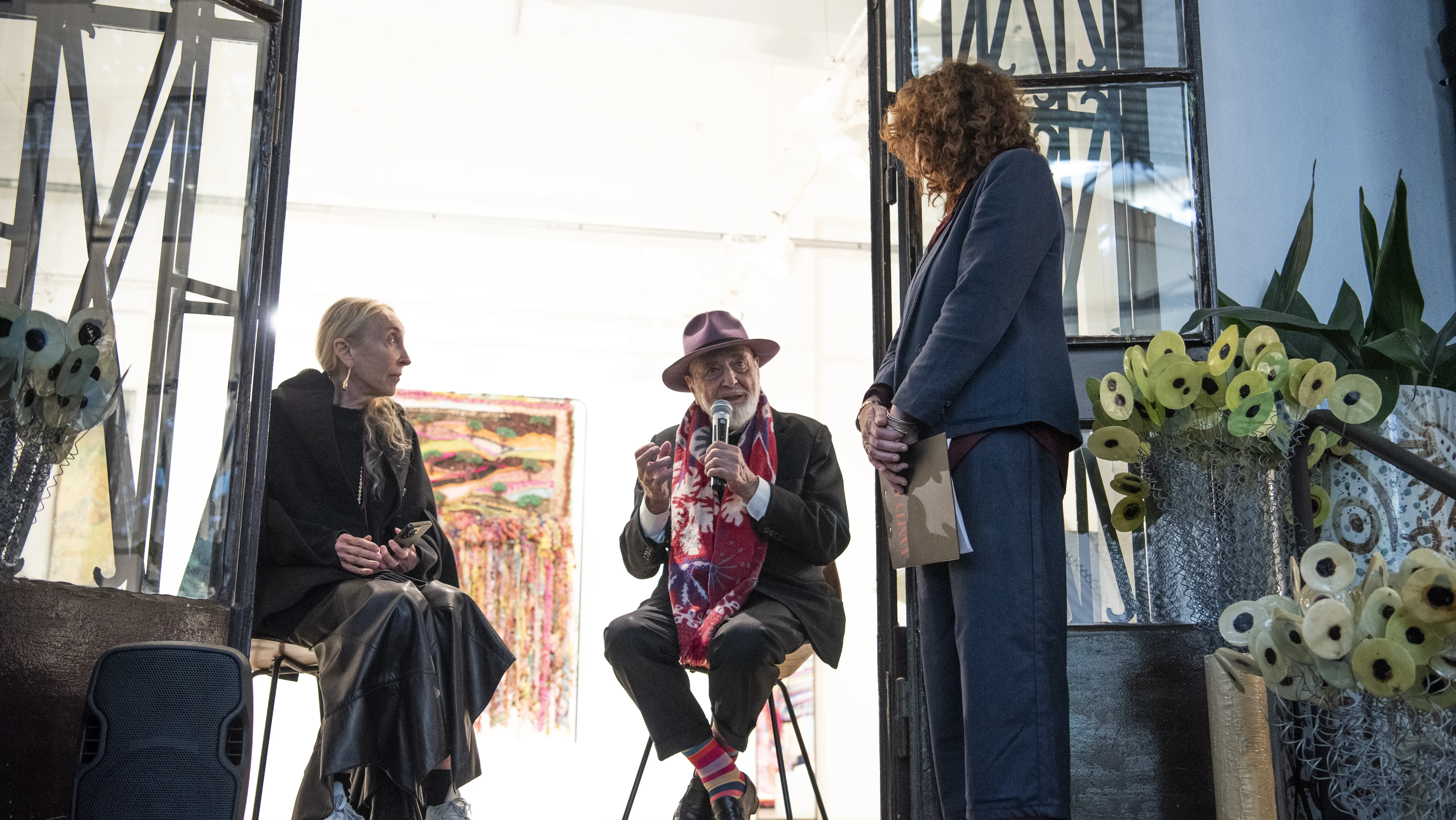
The program opened with an introduction by the Director of Cittadellarte, Paolo Naldini, followed by a guided tour of the Foundation. The exhibitions, artworks, and working spaces offered an initial level of immersion. “First we saw the exhibitions, listened to the explanations, and looked for inspiration,” explains Koide. “I saw that the students received many stimuli. When the workshop began, they immediately wanted to start creating.”
The workshop was curated by designer Tiziano Guardini, conceived and coordinated by Olga Pirazzi, Head of the Fashion Office at Fondazione Pistoletto, with the support of Luisa Mertina and Melina Uchoa. The work focused on creative upcycling: each student was provided with a base jacket made from fabrics sourced from local Biella stock—companies belonging to the Fashion B.E.S.T. platform.
Starting from that structure, the participants embarked on a transformation process that required clear and conscious choices: deconstructing, cutting, removing, replacing, applying inserts, and integrating manual techniques such as crochet using reclaimed materials.


It was not merely a matter of modifying a garment, but of rethinking it from within. “If you don’t open your mind, you lose intuition,” observes Masato Koide, describing his teaching approach. The goal was not to achieve a uniform aesthetic result, but rather to bring out a personal stance in relation to the theme of circularity. In this sense, the experience at Cittadellarte took on a precise value: positioning sustainability not as a technical constraint, but as a cultural choice. “Sustainability is something that is not always visible,” Koide continues. “You have to go deep into the subject, and art can create a pathway to reach it.”
Alongside the upcycling module, the students also worked on natural dyeing with designer Giulia Perin from the brand Emina Batik. In the workshops led by Perin, the students experimented with immersion techniques, painting, and printing using natural elements collected within the spaces of the Foundation, observing how color reacts to temperature and material.
The days were intense, marked by moments of informal exchange and continuous dialogue—not only between students and professors, but also with the designers who led the workshops and with the Fashion B.E.S.T. team, who closely followed the evolution of the projects, accompanying the process and recognizing in the works a surprising quality in terms of depth and coherence.


On the afternoon of February 19, the workshops at Cittadellarte were transformed into a photographic set. The finished jackets were worn by the very students who had designed and created them. In a focused yet light atmosphere, the young women in front of the camera began to move naturally—at first with measured gestures, then letting themselves go into small dance steps, smiles, and exchanged glances. Their energy stemmed from recognizing themselves in the garments they were wearing.
Masato Koide and Yuto Arita observed the scene with quiet satisfaction. For both—who, alongside teaching, run their own brands and are familiar with every stage of the production process, from sketch to pattern-making to garment construction—seeing the students move through all phases, from inspiration to public presentation, represents a fundamental step. “Experience creates the future,” affirms Koide. “It is not an immediate result, but a deposit that will continue to work over time.”
This new chapter in the collaboration between Osaka and Biella confirms the strength of an educational and cultural exchange: in three days, a space was created in which art and fashion engaged in dialogue without overlapping, where sustainability was addressed both as a concrete practice and as an open question. The jackets created will remain as a visible trace of the workshop, but, as Professor Koide suggests, the deeper work will continue elsewhere, in the individual paths of each student.


Notes to the article
The ten students from the three-year Fashion Program of the Maronie College of Fashion Design in Osaka are: Rin Shiraishi, Kotone Mori, Ami Maeda, Yuna Kitagawa, Koyuki Kamioka, Sayaka Fukunaga, Momoka Otoide, Misaki Ijima, Yanghyang Byun, and Hiyori Eguchi.
Professor Masato Koide runs the brand Atelier M/A.
Professor Yuto Arita runs the brand Arita Yuto Kengai.